Felt is one of those materials that quietly shows up everywhere. It lines the inside of your jewellery box, cushions the legs of your furniture, insulates your walls, wraps around industrial machinery, and adds texture to handmade crafts. It’s been around for thousands of years and yet, in today’s manufacturing and export market, it remains as relevant and in-demand as ever.
If you’re a buyer, a maker, a business owner, or someone exploring global sourcing options, understanding the two dominant types of felt wool felt and polyester felt can save you time, money, and a lot of second-guessing. This guide breaks both down clearly, compares them honestly, and explains what to look for when sourcing from a felt exporter.
What Is Felt, and Why Does It Still Matter?
Before diving into wool versus polyester, it helps to understand what makes felt unique as a material.
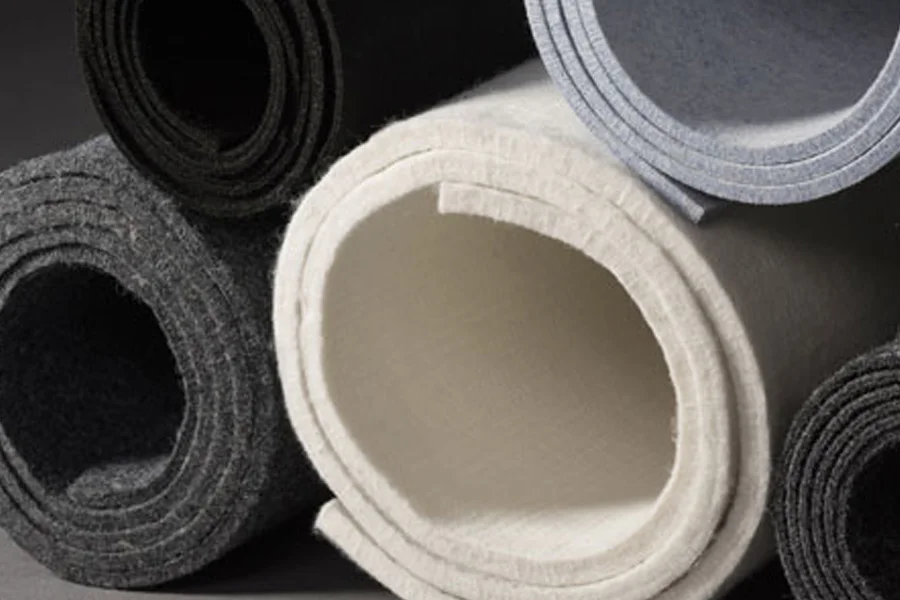
Unlike woven or knitted fabrics, felt is a non-woven textile. It’s made by matting and compressing fibers together either through heat, moisture, and pressure (for wool), or through needle-punching and heat bonding (for synthetic fibers like polyester). The result is a dense, stable material with no fraying edges, no weave structure, and a remarkably wide range of applications.
Felt doesn’t unravel when cut. It can be shaped, layered, glued, sewn, or moulded. It’s naturally sound-absorbent, thermally insulating, and available in virtually any thickness or density. These properties make it useful in industries as different as fashion, automotive manufacturing, construction, musical instruments, arts and crafts, and industrial filtration.
Two types of felt dominate the global market today: wool felt and polyester felt. They share a form but differ significantly in origin, performance, and application.
Wool Felt: Natural, Premium, and Time-Tested
Wool felt is exactly what the name suggests felt made from natural wool fibers. The wool is cleaned, carded, and then subjected to a felting process that uses moisture, heat, and agitation to cause the fibers to interlock permanently. No adhesives, no synthetic binders. Just fiber, pressure, and process.
What Makes Wool Felt Special
The natural structure of wool fiber is what makes it felt so effectively. Each strand of wool is covered in microscopic scales. When exposed to heat and friction, these scales open up and hook into neighboring fibers, creating a dense, locked structure that holds its shape without any additional bonding agent.
This natural interlocking gives wool felt a set of properties that are hard to replicate synthetically:
Softness and texture: Wool felt has a warmth and tactile quality that is immediately noticeable. It feels premium in the hand which is why it’s the material of choice for high-end fashion accessories, millinery (hat-making), fine stationery products, and luxury home goods.
Natural resilience: Wool fibers have a natural spring to them. Wool felt compresses under load and recovers when the pressure is removed. This makes it excellent for padding, cushioning, and protective applications.
Thermal and acoustic insulation: Wool is naturally insulating it traps air within its fiber structure, which slows heat transfer and absorbs sound. Wool felt panels are used in acoustic wall treatments, musical instrument pads (piano hammers are a classic example), and building insulation.
Moisture management: Wool can absorb moisture without feeling wet to the touch and releases it slowly. This makes wool felt comfortable in apparel applications and resistant to condensation in certain industrial uses.
Eco-friendly credentials: Wool is a renewable, biodegradable natural fiber. For buyers and brands with sustainability commitments, wool felt is an attractive material that fits into circular economy principles.
Where Wool Felt Is Used
- High-end fashion: hats, bags, slippers, scarves, decorative accessories
- Musical instruments: piano hammers, organ pads, dampening components
- Stationery and desk accessories: pen rolls, desk pads, notebook covers
- Home décor: wall panels, coasters, table runners, plant holders
- Arts and crafts: premium craft projects, children’s educational materials
- Industrial applications: precision wiping, polishing, and sealing where natural material is preferred
Wool Felt in the Export Market
Globally, wool felt is produced in countries with strong wool industries including India, New Zealand, Germany, and parts of Eastern Europe. Indian wool felt exporters in particular have built a strong reputation for producing quality felt at competitive prices, serving buyers in Europe, the United States, Japan, and the Middle East.
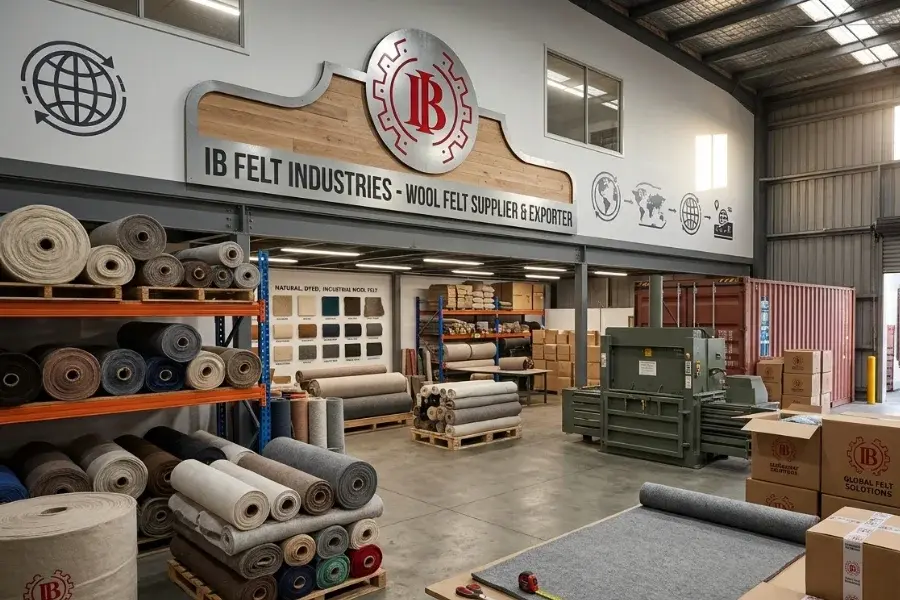
A reliable wool felt exporter offers products across a range of grades (from craft-grade to industrial-grade), customizes thickness and density to order, and provides consistent color matching for fashion and décor buyers. When evaluating a wool felt exporter, look for transparency about wool sourcing, production certifications, and the ability to handle both small sample orders and large commercial volumes.
Polyester Felt: Versatile, Durable, and Widely Used
Polyester felt is made from synthetic polyester fibers rather than natural wool. The most common manufacturing method is needle-punching thousands of barbed needles mechanically interlock the polyester fibers into a cohesive sheet. Heat bonding can also be used to add firmness and stability.
Polyester felt doesn’t have the long natural history of wool felt, but it has found an enormous market because of its practical advantages and significantly lower cost.
What Makes Polyester Felt Stand Out
Cost-effectiveness: Polyester is a synthetic material produced at scale, which means polyester felt is considerably more affordable than wool felt. For applications where large volumes are needed packaging, industrial lining, automotive parts, construction polyester felt offers the structural properties required at a fraction of the price.
Consistency: Because it’s manufactured from synthetic fibers in controlled conditions, polyester felt can be produced with a high degree of uniformity. Thickness, density, and weight remain consistent across large production runs something that can be harder to guarantee with natural fiber materials.
Moisture resistance: Unlike wool, polyester doesn’t absorb water. Polyester felt repels moisture rather than holding it, making it the better choice for outdoor applications, damp environments, or any use case where contact with water is likely.
Durability under stress: Polyester felt holds up well under repeated mechanical stress, abrasion, and UV exposure. In industrial applications, where materials are pushed hard, polyester felt tends to outlast natural alternatives.
Color variety: Polyester fibers accept dye easily and hold color well, even over long periods. Polyester felt is available in a much wider range of bright, vibrant colors than wool felt which is why it dominates the craft and hobby market for casual projects.
Flame-resistant options: Certain grades of polyester felt can be treated to meet fire resistance standards, making them suitable for construction, transportation, and public space applications where flammability requirements apply.
Where Polyester Felt Is Used
- Automotive industry: door panel liners, trunk liners, sound dampening, heat shields
- Construction: underlayment, insulation boards, roofing components
- Packaging: protective padding, gift box liners, product presentation
- Arts and crafts: school projects, hobby crafting, seasonal decorations
- Filtration: air and liquid filtration media in industrial systems
- Furniture: furniture base pads, drawer liners, upholstery backing
- Geotextiles: soil stabilization, drainage layers in civil engineering
Polyester Felt in the Export Market
Polyester felt is one of the most widely traded textile materials globally. India, China, South Korea, and Taiwan are among the largest producers and exporters. Indian polyester felt exporters have grown significantly in market share over the past decade, offering buyers quality products with competitive lead times.
For international buyers sourcing polyester felt, consistency is the most critical factor. A dependable polyester felt exporter should be able to provide material test reports, maintain batch consistency across large orders, and offer customization in terms of weight (GSM), thickness, roll width, and cut sizes. Most serious industrial buyers also expect compliance documentation fire ratings, chemical safety certifications, and origin certificates for customs purposes.
How to Choose the Right Felt Exporter
Whether you’re sourcing wool felt or polyester felt, the exporter you work with will define your experience as much as the material itself. Here’s what to evaluate:
Product range and customization: A good exporter should be able to offer multiple thicknesses, densities, and sizes not just standard catalogue items. If you have specific requirements, they should be able to accommodate custom orders.
Sample policy: Before committing to a large order, always request samples. Any serious exporter will provide samples, and the quality of those samples tells you a great deal about what a full production run will look like.
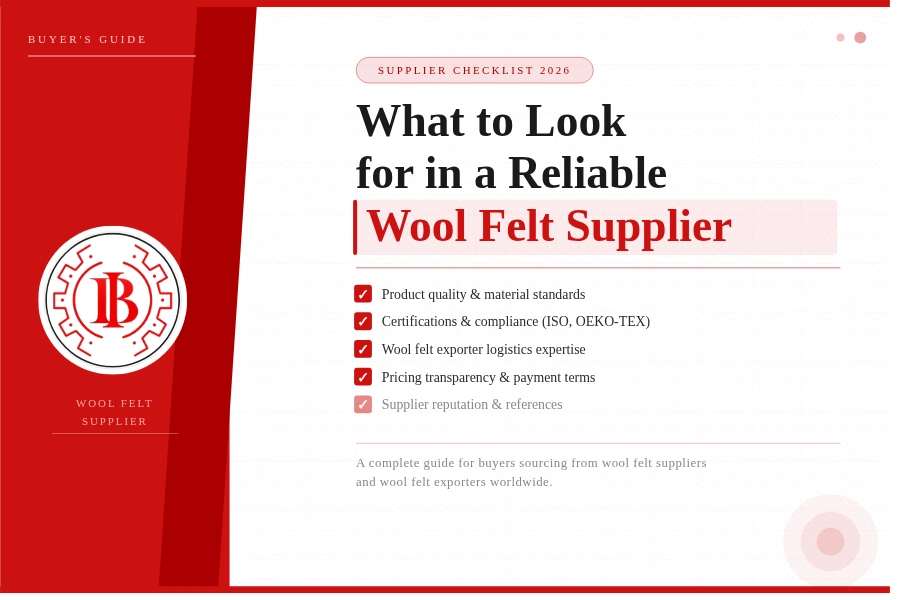
Certifications and compliance: Depending on your market, you may need OEKO-TEX certification (for textiles that contact skin), ISO quality certifications, fire resistance ratings, or specific customs documentation. Confirm that the exporter can provide what your buyers or regulators require.
Production capacity and lead times: If you need consistent supply across multiple seasons or production cycles, understand the exporter’s capacity and their realistic lead times. A good supplier is honest about what they can deliver and when.
Communication and responsiveness: International sourcing involves time zones, language differences, and the need for clear written communication. An exporter who responds promptly, answers questions precisely, and proactively shares relevant updates is worth a premium over one who’s hard to reach.
Minimum order quantities: Smaller buyers need exporters who can accommodate lower MOQs, especially for initial trial orders. Larger buyers need assurance that the supplier can scale without compromising quality.
Felt whether wool or polyester is a material with extraordinary versatility and a proven track record across industries. Understanding the differences between wool felt and polyester felt is the foundation of making the right sourcing decision, whether you’re a designer looking for premium natural material, a manufacturer sourcing industrial components, or a brand building a product line around sustainable materials.
The global felt export market is active, competitive, and capable of delivering excellent products at fair prices provided you work with the right partners. A trustworthy wool felt exporter or polyester felt exporter will combine quality manufacturing with transparent communication and reliable supply chains.
Take the time to compare samples, ask the right questions, and build supplier relationships that go beyond a single transaction. The best sourcing decisions are the ones that hold up not just on the first order but across every order that follows.