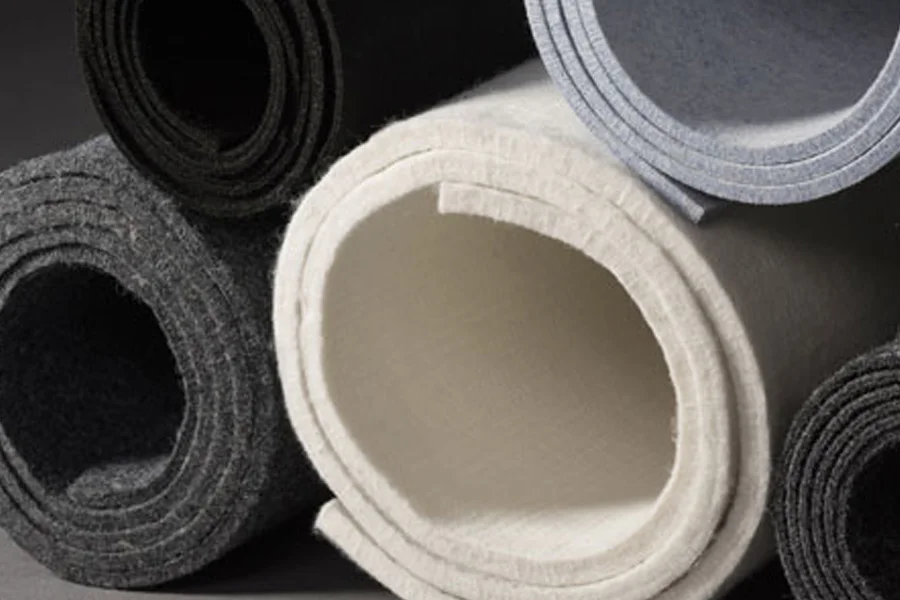
Felt looks simple from the outside. It’s just compressed fiber, right? But anyone who’s ordered the wrong felt sheet for a project knows the difference between “close enough” and “actually works” can be significant. A gasket that’s too soft compresses unevenly. A crafting sheet that’s too dense won’t hold a clean fold. The wrong choice usually doesn’t fail dramatically, it just quietly underperforms.
Thickness and density are the two specs that matter most, and they’re often confused with each other. This guide walks through what each one actually controls, how to match them to your application, and what to check before placing a bulk order.
Thickness and Density Aren’t the Same Thing
It’s worth clearing this up first, because the two terms get used almost interchangeably, and that leads to mismatched orders more often than you’d think.
Thickness is simply how tall the material is, measured in millimeters or fractions of an inch. Density refers to how tightly the fibers are packed within that thickness. You can have two felt sheets of identical thickness that behave completely differently because one is loosely pressed and the other is compacted hard.
Think of it like comparing a thick, fluffy towel to a thin, tightly woven one. Thickness alone tells you almost nothing about how the material will perform under pressure, friction, or load. Density is usually the bigger factor in how felt actually behaves in use.
Why Density Usually Matters More Than People Expect
Density affects compression resistance, durability, and how the felt handles repeated stress. A low-density sheet compresses easily and recovers slowly, sometimes not fully at all after repeated use. A high-density sheet holds its shape but has less give, which matters for anything requiring flexibility or cushioning.
For industrial applications, gasketing, padding, vibration dampening, density is often the deciding factor over thickness. A gasket needs enough density to maintain a consistent seal under pressure without becoming so rigid that it can’t conform to slight surface irregularities. Get the density wrong, and even a perfectly measured thickness won’t save the application.
Matching Thickness and Density to Common Applications
There’s no single “correct” felt sheet. The right combination depends entirely on what the material needs to do. Here’s how that breaks down across a few common use cases.
Gasketing and sealing. These applications generally call for medium to high density, since the felt needs to resist compression set over time while still forming a tight seal. Thickness varies depending on the gap being sealed, but density consistency matters more than hitting an exact thickness number.
Vibration dampening and padding. Lower to medium density often works better here, since some compressibility is actually the point. A pad that’s too dense won’t absorb shock effectively. Thickness tends to scale with how much dampening is needed, thicker pads for heavier equipment, thinner ones for lighter applications.
Crafts and decorative use. Density needs are more forgiving here, but consistency still matters for anything requiring clean cuts or folds. A lower-density sheet is easier to cut with scissors or a craft knife, while a firmer sheet holds detail better for shapes that need to keep their form.
Polishing and finishing applications. This is where felt takes on a different role entirely, less about sheets and more about shaped components like felt polishing rings, used in metal, jewelry, and glass finishing work. Here, density directly affects cutting action. A harder felt ring cuts more aggressively and works well for initial polishing stages, while a softer ring is better suited to final finishing passes where a gentler touch preserves detail. Buyers assembling or restocking polishing kits often need a mix of densities to cover the full progression from rough polish to mirror finish, rather than a single uniform grade.
Instrument and mechanical padding. Applications like piano hammers or mechanical dampeners often require very specific, tightly controlled density, since inconsistency directly affects sound or function. This is one area where cheap felt sheets tend to show their limitations quickly.
How to Read a Felt Spec Sheet Properly
When a supplier sends a spec sheet for felt sheets, a few numbers matter more than others, and it helps to know what you’re actually looking at.
Density is often listed in pounds per cubic foot or grams per cubic centimeter, depending on the supplier’s region. Higher numbers mean firmer material. Thickness tolerance matters too, since a stated thickness with a wide tolerance range can create inconsistency across a bulk order, especially in gasketing applications where a tight tolerance is critical.
Hardness or firmness ratings sometimes appear as a separate spec from density, particularly for felt used in polishing and finishing work. This rating gives a more direct sense of how the material will feel and perform in use, which matters more than raw density numbers for applications like felt polishing rings, where feel under load is the whole point.
If a spec sheet only lists thickness without any mention of density or firmness, it’s worth asking directly. A supplier who can’t provide that detail may not have tight control over their own production consistency.
Testing Before You Commit to a Bulk Order
Specs on paper only tell part of the story. Requesting samples before placing a large order is standard practice, and it’s worth testing samples the way the material will actually be used, not just checking them by hand.
For gasketing, that means compressing a sample under realistic pressure and checking recovery. For polishing rings, it means actually running a test pass on the material you’ll be finishing, since cutting action can vary even between sheets with similar listed density. For crafting or padding use, folding, cutting, or cushioning tests under normal conditions give a much better sense of real performance than the spec sheet alone.
This step catches a surprising number of mismatches before they become expensive problems. It’s a lot cheaper to discover a density issue on a small sample than after a full bulk shipment arrives.
Common Mistakes Buyers Make
A few patterns come up repeatedly when buyers end up with the wrong felt for their project.
Assuming thicker automatically means better. Thickness alone doesn’t determine performance, and ordering a thicker sheet to “be safe” often just adds cost without solving the actual problem, which is usually a density mismatch.
Not accounting for compression over time. Felt that performs well fresh out of the package can behave very differently after months of repeated compression. Lower-density material tends to lose recovery faster, which matters for long-term gasketing or padding use.
Treating all felt polishing rings as interchangeable. Density and hardness make a real difference in polishing results, and using one grade across an entire finishing process, from rough cutting to final polish, usually produces inconsistent results. A proper polishing kit typically includes a range of densities for a reason.
Skipping the sample stage to save time. It’s tempting to order based on spec sheets alone, especially under a deadline, but the cost of a mismatched bulk order almost always outweighs the time saved by skipping a sample test.
A Simple Framework for Choosing
If you’re not sure where to start, this rough sequence works for most buyers:
- Define what the felt actually needs to do, seal, cushion, cut, or hold shape.
- Identify whether density or thickness matters more for that function (density usually does).
- Request samples across a couple of density options rather than committing to one based on a spec sheet alone.
- Test under realistic conditions, not just by hand.
- Confirm tolerance ranges before placing a bulk order, especially for gasketing or precision applications.
Bringing It All Together
Choosing the right felt sheet comes down to understanding that thickness and density solve different problems, and most performance issues trace back to density, not thickness, being mismatched to the job. Whether you’re sourcing felt sheets for industrial gasketing, padding, crafts, or assembling felt polishing rings into a complete finishing kit, the specs on paper are only a starting point.