Every industrial buyer in India has faced that moment: you request quotes from three different conveyor belt suppliers and get three numbers that seem to have no logical relationship to each other. One quotes ₹1,800 per meter, another ₹3,200, and a third hovers somewhere in between. You’re left wondering whether the cheaper option will fail prematurely or whether you’re simply overpaying for something you could get for less.
The confusion around conveyor belt prices makes purchasing decisions harder than they should be. You’re not just buying a length of rubber you’re investing in a system component that will affect your production uptime, maintenance costs, and overall operational efficiency for years. Understanding what drives these pricing differences puts you in a much stronger position when negotiating with any conveyor belt supplier.
This guide breaks down the specific factors that determine conveyor belt prices in the Indian market, helps you compare quotes on a fair basis, and gives you practical criteria for choosing the right belt without overcommitting your budget.
What Actually Determines Conveyor Belt Prices
The biggest misconception is that conveyor belt prices are fixed that there’s a standard rate per meter that every supplier follows. In reality, your final price depends on a combination of factors specific to your application, and savvy buyers learn to align these specs with what they actually need rather than defaulting to the most expensive or cheapest option.
Belt Material and Construction Type
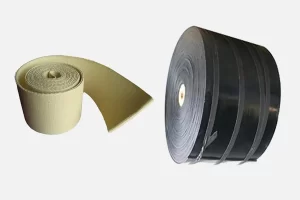
The base material of your belt has the largest impact on pricing. The most common types available from any conveyor belt supplier in India include rubber compounds, PVC, and specialty materials for extreme conditions.
Rubber belts remain the workhorse of Indian industry because they handle heavy loads and resist abrasion well. A standard multi-ply rubber belt with EP (polyester-nylon) fabric reinforcement typically ranges between ₹1,500 and ₹2,800 per meter depending on specifications. PVC belts preferred in food processing and pharmaceutical applications where clean ability matters fall in a similar range but often command a slight premium for food-grade certifications.
The critical choice is matching material to your actual operating conditions. A belt rated for hot materials (sintered ore, for instance, can reach 400°C at the loading point) costs significantly more than a standard abrasion-resistant belt, but using an under-specified belt in that application means you’ll replace it within months, making the “cheaper” option far more expensive over time.
Belt Width and Thickness Specifications
Width directly increases material costs because wider belts require more raw rubber and fabric. A 1,200mm belt costs considerably more than an 800mm belt not because of complexity but simply because more material goes into it.
Thickness specifications follow a similar logic. Single-ply belts work for light-duty applications, but heavy-duty mining or aggregate handling requires multi-ply construction typically a multiply rating of 3, 4, or even 6 plies depending on the load. Each additional ply adds both material cost and belt strength. The key is matching thickness to your load weight and impact conditions rather than automatically selecting the thickest available belt.
Most Indian industrial applications work well with 3-ply or 4-ply construction. Going heavier only makes sense when you’ve calculated your actual tension requirements and identified specific need for higher belt strength.
Hidden Cost Factors That Suppliers Don’t Always Explain
Beyond the visible belt specifications, several less-discussed factors significantly affect your total cost of ownership. Understanding them helps you evaluate quotes on a more complete basis.
Belt Length and Minimum Order Quantities
Suppliers often price shorter lengths at higher per-meter rates because fixed setup costs get spread across less material. If you need a 50-meter belt for your maintenance requirement but a supplier quotes for 100 meters minimum, you’re either buying more than needed or paying a premium for smaller volume.
Building a relationship with one conveyor belt supplier for recurring belt requirements often yields better per-meter pricing over time, particularly for standard replacement belts in ongoing operations. Some buyers successfully negotiate annual supply agreements that lock in favorable pricing even for smaller orders.
Accessories and Add-On Components
The belt itself is only part of what you need for a functioning conveyor system. Accessories like belt scrapers, cleaners, tracking guides, and pulley lagging services significantly affect your final expenditure and these often appear as separate line items rather than being built into an initial belt quote.
When comparing quotes, always ask for itemized pricing that includes whatever accessories your installation requires. A ₹20,000 difference in belt price might look significant until you realize one quote excludes conveyor belt scrapers that another includes.
How to Compare Quotes From Different Suppliers on Equal Terms
Getting accurate quotes requires clarity about your actual requirements. Vague inquiries produce vague (and often inflated) quotes because suppliers build in safety margins for unknowns.
Define Your Operating Conditions Clearly
Before approaching any conveyor belt supplier, document your specific conditions: the material being handled (including particle size and moisture content), expected throughput in tons per hour, the maximum temperature at loading points, and whether the application involves CHEMICAL exposure to oils, acids, or other corrosive substances. Length and elevation change in your conveyor run also affect belt selection.
Suppliers pricing against clearly defined specs can offer more accurate quotes because they know exactly what belt specification matches your needs. Vague requests like “need a heavy-duty belt for our plant” invite quote inflation.
Request Complete Specifications, Not Just Pricing
A proper quote from a reputable conveyor belt supplier includes belt specifications: the rubber compound designation (which indicates oil resistance, heat resistance, and other properties), the number of plies and their fabric type (EP 80, EP 100, NN 100, etc.), belt thickness in millimeters, and the breaking strength rating.
If a quote doesn’t include these details, you’re comparing unknown quantities and the cheapest initial quote often becomes expensive when you receive a belt that doesn’t perform in your actual conditions.
Evaluate Total Cost of Ownership, Not Just Unit Price
A premium belt that costs ₹500 more per meter but lasts twice as long in your application represents better value than replacing a cheaper belt twice as often. Ask suppliers for expected service life in your specific conditions, not just their standard warranty period.
For applications like aggregate handling or mining where belt wear accelerates, this calculation often favors slightly higher initial investment. The math is straightforward: a belt that costs ₹2,500 per meter and lasts six months versus a belt at ₹3,200 per meter lasting twelve months makes the second option more economical despite the higher unit price.
Questions That Reveal Supplier Credibility
Not all conveyor belt suppliers in India offer the same level of expertise or after-sales support. The questions you ask and how they answer reveal a lot about who you’re working with.
Ask About Their Experience in Your Specific Industry
A supplier with deep experience in cement plants understands different requirements than one who primarily serves food processing or mining operations. The knowledge shows up in recommendations for belt specifications that match real-world conditions rather than generic suggestions.
Inquire About Technical Support and Installation Guidance
Reputable suppliers don’t simply ship belts and disappear. They offer guidance on proper installation tension (critical for belt life), recommendations for tracking adjustments, and support when unexpected issues arise. This matters because the difference between a belt that performs well and one that fails prematurely often comes down to installation practices.
Understanding Warranty Terms and What They Actually Cover
A warranty sounds reassuring until you read the conditions. Some warranties cover only manufacturing defects not premature wear from misapplication. Others pro-rate coverage, meaning compensation decreases as the belt ages. Make sure you understand what happens if your belt fails unexpectedly and whether the supplier stands behind their product in meaningful ways.
Making Your Final Decision
After evaluating specifications, comparing quotes on an equal basis, and checking supplier credibility, your decision should focus on the right balance of upfront cost and long-term value.
When to Prioritize Lower Cost
If your application involves light materials, controlled conditions, and easy replacement access, you don’t need premium specifications. Focus on getting the right basic specifications at a competitive price rather than paying for overkill.
When to Invest in Higher Specifications
High-temperature applications, heavy loads, abrasive materials, continuous operation, and difficult conveyor access all argue for higher-quality belts even at premium pricing. Downtime for belt changes in complex installations costs far more than the price difference between standard and premium belts.
What to Do Next
Now that you understand what drives conveyor belt prices and how to evaluate quotes on a fair basis, the next step is straightforward. Take the time to clearly define your actual operating conditions before reaching out to suppliers. The precision in your inquiry gets answered with more accurate pricing, and you avoid paying for unnecessary specifications or receiving belts that fail in your conditions.
Document your material type, throughput requirements, temperature conditions, and any chemical exposure. Get quotes with full specifications from multiple suppliers, compare them item by item, and make your decision based on total cost of ownership rather than unit price alone. The effort you invest in this evaluation phase pays dividends throughout the years your conveyor belt keeps running.